On Feb. 23, 2026, the Media trolley got slower. The Delco Today report on the change said a new Communications-Based Train Control system would add about 15 minutes to D1 trips from Orange Street in Media to 69th Street in Upper Darby, and about 10 minutes to D2 trips from Sharon Hill. The system makes operators accelerate and brake more gradually, enforces speed limits, and can stop a trolley automatically. It took a decade and $75 million to install.
In September, SEPTA published Accelerate, a 10-year vision. It promises the same D line 15-minute peak service, accessible stations with shelters and real-time arrival information, and a fleet of new low-floor trolleys.
So the trolley got slower this year, and the plan for it promises much more. A buyer weighing a house in Springfield, Drexel Hill or Media Borough is pricing one of those two versions of the line, whether they mean to or not. The research on rail and home values points to the one that runs today.
The value follows the trains
In April 2025, SEPTA published an Econsult analysis of the funding crisis. It found that SEPTA service was associated with a premium of about $17,900 per suburban household, based on 2022 housing values. Across the region, that premium was 5.8% of housing value.
The more useful part for a Delaware County buyer is a scenario table. It estimates what single-family homes within three miles of a line would lose if that Regional Rail line were abandoned. On Paoli/Thorndale, the modeled loss was $56,800 per household across 122,200 homes. On Wilmington/Newark, which runs through Delco's river towns, it was $6,600 per household across 103,800 homes. Both lines have stations and both reach Center City. The model gave one roughly eight times the per-household value of the other.
An earlier analysis points the same way. In March 2018, The Philadelphia Inquirer reported on a SEPTA and Econsult study. It found premiums of $17,300 to $46,600 per house in some suburban neighborhoods within walking distance of a station, and larger premiums near stations with more lines and more peak-hour trains. Those are older estimates, but the pattern matches the 2025 table. These studies attach value to frequent service, not to having a station in town.
That is how to read Accelerate. If 15-minute service arrives in Delaware County, it adds the kind of frequency these studies tie to value. Until then, the trains running today are what a house near the tracks is worth paying for.
What the plan names in Delaware County
The plan's headline Regional Rail promise is train service every 15 minutes or better, seven days a week, at nearly half of SEPTA's 155 stations. The 15-minute destinations it lists are Airport, Wawa, Fox Chase, Paoli, Chestnut Hill East and Norristown, on three new "S Lines." Wawa, at the outer end of the Media/Wawa line, is the one in Delaware County.
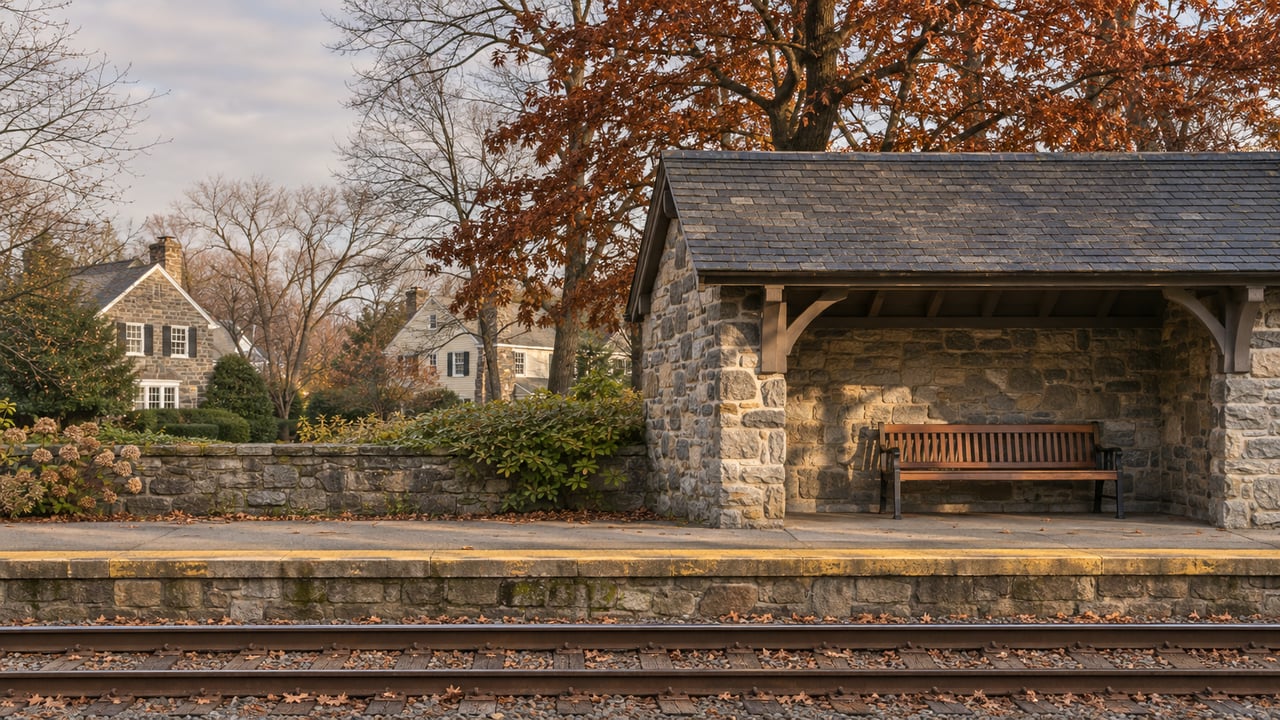
The longer Regional Rail master plan behind Accelerate joins the Wawa line to Chestnut Hill East as the S2. It describes the Media/Wawa corridor as one that serves walkable Delaware County communities. The corridor maps show Primos, Secane, Morton, Swarthmore, Wallingford, Media and Wawa. In the phasing document, the first step for the S2 is 30-minute all-day service, and 15-minute all-day service is the long-term goal. Those phases start with one labeled 2030 to 2035 and end with one labeled 2050 to 2055.
The Wilmington/Newark line is not one of the 15-minute destinations. The master plan gives it 30-minute service as far as Marcus Hook and says carrying that frequency on to Wilmington depends on funding from the state of Delaware. On the Airport Line, the plan names Eastwick as the only station with a low-level platform. It treats clearing bottlenecks on the Airport and Norristown branches as a requirement for S1 service.
For the trolleys, the plan adds stop consolidation, traffic-signal priority, and a peak period that starts at 2 p.m. to cover school dismissal and flexible workdays. The Inquirer's Nov. 13 report summed up the trolley piece as a new fleet "with stations instead of corner stops." At 69th Street, Accelerate describes a mixed-use project and a full renovation of the South Terminal bus facility. Both the D line and the Market-Frankford L would be part of that hub.
The new trolleys are the part furthest along, and their timeline has moved. In February 2023, SEPTA awarded Alstom a base order for 130 trolleys worth $714,239,455. At that time it said deliveries would start in 2027 and finish by the end of 2030, and that it was still seeking more than $800 million in grants and state and local money for the improvements needed for level boarding. SEPTA's current trolley vehicle timeline lists manufacturing in 2027 to 2030 and fleet delivery and deployment in 2030 to 2034. If a buyer closes this winter on a home a few blocks from a D1 stop, the new cars and the stations that go with them belong to a later chapter of that ownership.
The money behind the promise
Accelerate does not give a total price or a final schedule. PhillyVoice's Sept. 22 coverage reported that the full vision needs more funding. The same report said SEPTA's temporary operating support runs out on July 1, 2027.
That support was $394 million in emergency funding, which Gov. Josh Shapiro authorized by executive action in 2025. According to the Inquirer's Nov. 13 report, it let SEPTA cover two years of operating costs with money the state had set aside for future SEPTA capital projects. SEPTA still projects a $192 million structural operating deficit next year.
The politics changed this month. The same Inquirer report noted that Democrats flipped the Pennsylvania Senate. That chamber's Republican leaders had blocked three Shapiro budget proposals to raise the share of sales tax dedicated to transit. Shapiro has said "we will fund transit" without saying how. SEPTA general manager Scott A. Sauer told the Inquirer, "I don't think that just because the Democrats have taken total control, this is now some cakewalk."
That leaves two open questions for Delaware County riders as the 2027 budget debate begins. One is how SEPTA pays for today's service after the emergency money runs out on July 1, 2027. The other is whether any of the Accelerate improvements get funded.
Service has changed quickly before
Delaware County has already seen how quickly service can change. In 2025, SEPTA's budget-driven cuts took effect in August. According to the Inquirer's Sept. 14, 2025 report, most of those cuts were reversed that Sunday, and SEPTA said Delaware County bus and trolley service would be back to normal the next morning.
Smaller interruptions are routine. SEPTA runs shuttle buses in place of D1 and D2 trolleys on the first Saturday of each month for overhead-wire inspection and maintenance, "until further notice." Its 2026 notices list the next one on Dec. 5. That doesn't count against a trolley-corridor home. It is simply how the line runs now, and it is the version of the line a buyer should price.
A market that leaves room to compare
The county's numbers give buyers room to compare homes by schedule. Bright MLS's October 2026 report, with data as of Nov. 6, shows the following for Delaware County in October 2026:
- a median sale price of $370,000, up 3.6% from October 2025, against $400,000 for the Philadelphia metro
- 418 closed sales, down 8.1%
- a median of 13 days on market
The same report counts 1,016 active listings in the county in October 2026. That is up 31.3% from a year earlier and equals 2.30 months of supply.
Thirteen days on market means good homes still sell quickly. With almost a third more listings countywide than last fall, a buyer has more room to compare a house near Swarthmore station with one near a Springfield trolley stop on the schedules that run now. The 2025 Econsult figures suggest frequent service is where value shows up.
Pricing a home on today's schedule protects the buyer either way. Frequent Wawa trains or new trolley stations would add value the owner never paid for, and a stalled budget would cost nothing that was built into the price. Our Delaware County neighborhood page has the towns along both corridors, and our look at Delco's most walkable downtowns covers several of the station towns. Transit decisions have shaped values across the river too, as our story on how a 1962 PATCO fight still sets Camden County prices shows.
If you're choosing between a Media/Wawa line address and a D1 or D2 trolley address, Gavin LaRocca is glad to go through specific homes on both with you, starting from the service that runs today. You can also start with a home valuation if you own near a station now. Let's Connect.